[Research] FMGodot Real Time 360 Stereoscopic Omni-Directional Panorama

FM Godot
- Customised edition based on Godot Engine 4.7
- Adding support of real time 360 stereo capture support by Leoson Cheong (CHEONG Tai Leong)
- Email: support@frozenmist.com
- Forum: Godot Official Discussion
- Forum: Godot Community Discussion
- Discord Discussion @FMLeoson
Breaking the Stitching Barrier: Real-Time 12K 360 Stereoscopic Rendering in Godot

Achieving high-fidelity, real-time omnidirectional stereoscopic (ODS) rendering has traditionally been a brute-force endeavor. Rendering a scene for VR, domed projections, or immersive video usually requires massive computational overhead to avoid visual artifacts.
Recently, I’ve been developing a purely mathematical approach to 360 stereoscopic rendering that bypasses these traditional bottlenecks. The theory is engine-agnostic—originally tested in Unreal Engine 5.7 as a lightweight alternative to NDisplay—but for this proof-of-concept, I’ve implemented it directly into a custom source build of Godot, which I’m calling FMGodot.
Here is a look at how this mathematical approximation works, why it outperforms traditional stitching, and how it handles 12K resolutions in real-time.
- Omnidirectional Result Projected onto a Planar Surface
| Camera3D (Left Eye) | Camera3D (Right Eye) |
|---|---|
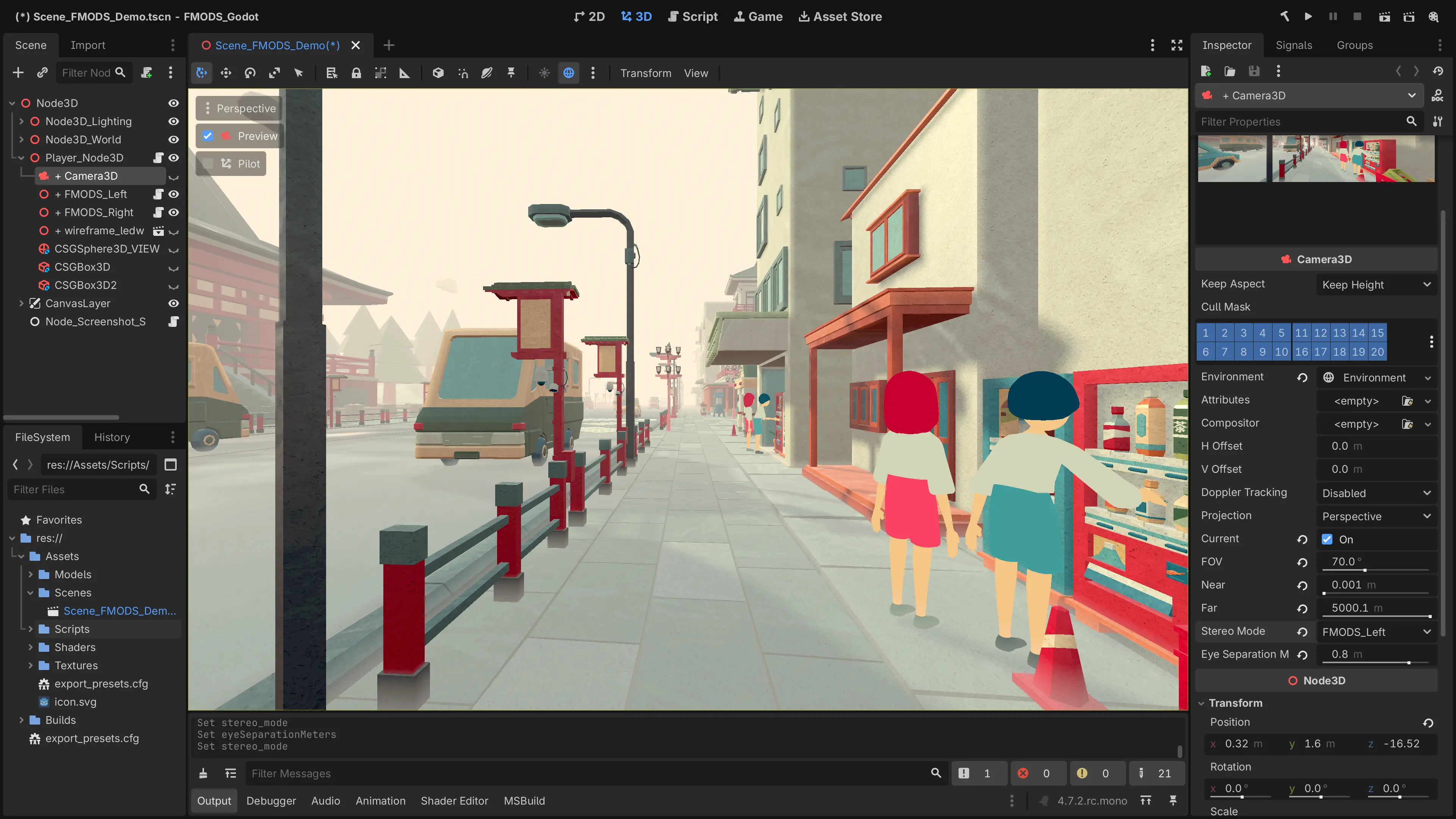 | 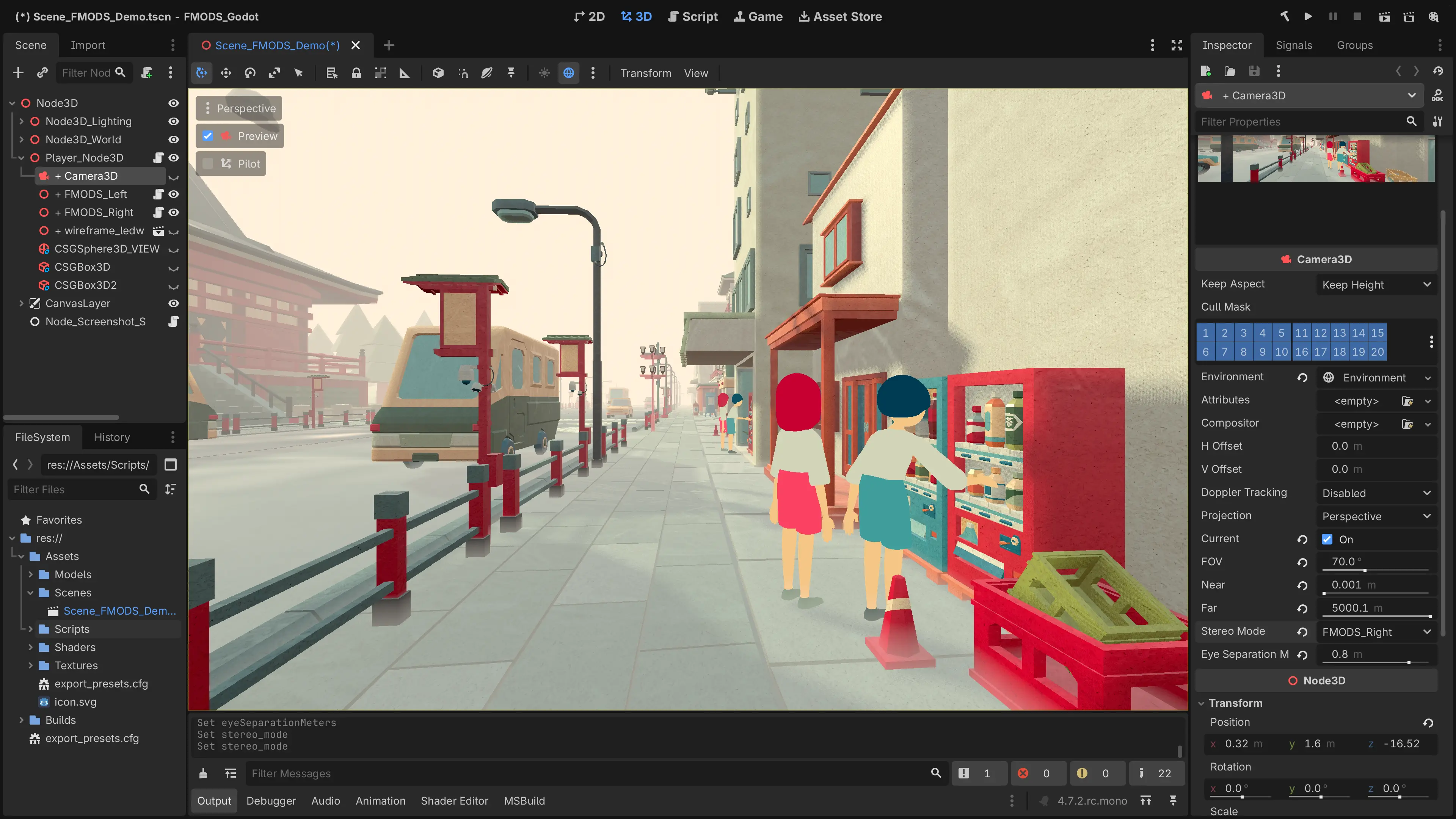 |
| exaggerated 80cm IPD | exaggerated 80cm IPD |
- Github repository: FMGodot
Work-in-progress...